
Hi, I'm Qvan Rov. I live in New York. Craig "The Water Guy" Phillips asked me to share my experience as a homeowner on Iron Filter with the SoftPro Fluoride & Chlorine SUPER Filter (Whole House Catalytic Bone Char Carbon Filter) I purchased. This is how my adventures played out. I hope this helps you in your decision.
Did you know that the average American household uses over 300 gallons of water daily, yet most of us have no idea what's actually flowing through our pipes?
I certainly didn't until eight months ago when I installed the SoftPro Fluoride & Chlorine SUPER Filter in my New York home. What started as a simple concern about chlorine taste turned into a complete transformation of our household water quality—and honestly, I wish I'd made this change years earlier.
The Wake-Up Call: When "Clean" Water Wasn't Clean Enough
Living in New York, I always assumed our municipal water was perfectly fine. Sure, there was that occasional chlorine smell when I filled a glass from the tap, and yes, my morning coffee sometimes had an off taste, but I chalked it up to normal city water quirks.
The real eye-opener came during a family dinner last spring. My mother-in-law, visiting from Vermont where they have well water, politely declined a second glass of our tap water. "It tastes like a swimming pool," she said with a grimace. That comment stung because it was true—I'd just become nose-blind to the chemical taste.
That same week, I noticed our white laundry was developing a dingy, yellowish tint despite using quality detergent. Our showerheads were accumulating buildup faster than usual, and my wife mentioned her skin felt dry after showers. These weren't dramatic problems, but they were persistent annoyances that added up.
What really concerned me was learning about fluoride levels in our municipal supply.
After doing some research, I discovered that while fluoride serves a purpose in dental health, many families prefer controlling their exposure rather than consuming it in every glass of water, cup of coffee, and home-cooked meal. The more I read about chloramine disinfection byproducts and their potential long-term effects, the more I realized we needed a comprehensive solution.
I started testing our water with basic TDS meters and chlorine test strips. Our municipal water was coming in at around 285 ppm total dissolved solids with chlorine levels consistently above 2.0 ppm—well within EPA guidelines but higher than I wanted for daily consumption. The chloramine odor was particularly strong during summer months when treatment levels increased.
Research Phase: Navigating the Overwhelming World of Water Treatment
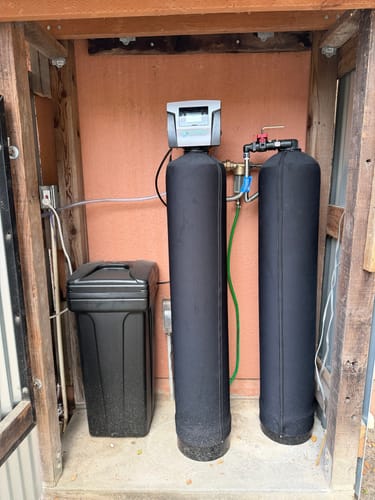
Once I decided we needed a whole-house solution, I fell down the rabbit hole of water treatment research. The options were overwhelming: standard carbon filters, KDF media, catalytic carbon, bone char, reverse osmosis, and combinations thereof. Each technology had passionate advocates claiming superiority.
My initial instinct was to go with a basic activated carbon system—they were cheaper and seemed straightforward. But as I dug deeper into the science, I learned that standard carbon filters struggle with chloramines, which our municipality uses instead of basic chlorine. Chloramines are more stable than chlorine, which makes them effective for water treatment plants but also means they're harder to remove at the point-of-use.
That's when I discovered catalytic carbon technology.
Unlike regular activated carbon, catalytic carbon is specifically engineered to break down chloramines through a catalytic reaction rather than simple adsorption. This means it doesn't just trap contaminants—it actually neutralizes them, leading to longer filter life and more consistent performance.
The fluoride removal aspect was another crucial factor. Most carbon systems don't touch fluoride, but bone char carbon has a unique affinity for fluoride ions. After reading studies about bone char's effectiveness and safety record, I became convinced this was the approach we needed.
I spent weeks comparing specifications, reading user reviews, and contacting manufacturers. Flow rate was critical since we're a family of four with typical peak usage demands. The SoftPro system's 15 GPM flow rate meant we wouldn't experience pressure drops during simultaneous water use—important when someone's showering while the dishwasher runs.
The system's NSF certifications for chlorine, chloramine, and taste/odor removal provided the third-party validation I needed. While bone char isn't NSF-tested for fluoride removal (due to testing protocol limitations), the extensive research and real-world performance data convinced me it was worth trying.
Unboxing and First Impressions: Quality You Can See
The SoftPro system arrived in two substantial packages—the main filter housing and a separate box containing the catalytic carbon and bone char media. My first impression was how robust everything felt. The housing is constructed from heavy-duty materials with brass fittings that inspire confidence in long-term durability.
The filter housing itself is larger than I expected—about the size of a small water heater—but the dimensions were clearly specified, so I'd planned accordingly. The powder-coated finish looks professional and should hold up well in our basement environment.
What impressed me most was the quality of the included documentation.
The installation manual was clearly written with detailed diagrams, and the system specifications were comprehensive. SoftPro included information about media types, expected performance parameters, and maintenance schedules—details that showed they stand behind their engineering.
The media itself arrives separately, which initially seemed inconvenient but actually makes sense for shipping and handling. The catalytic carbon is a different grade than standard carbon—you can see the difference in particle size and surface texture. The bone char has a distinctive appearance and comes with clear handling instructions.
Installation Experience: Easier Than Expected

I'll be honest—I was intimidated by the prospect of installing a whole-house system. While I'm reasonably handy, plumbing has never been my strong suit, and the idea of cutting into our main water line felt daunting.
After getting quotes from three local plumbers (ranging from $450 to $750 for installation), I decided to attempt the DIY route. The savings were significant, and frankly, I wanted to understand exactly how the system worked.
The installation took me most of a Saturday, including multiple trips to Home Depot for fittings I hadn't anticipated needing. The most challenging part was creating the bypass loop, which required precise measurements and several pipe cuts. SoftPro's manual recommended specific bypass valve configurations, and I'm glad I followed their guidance rather than improvising.
The actual filter housing installation was straightforward once the plumbing connections were ready.
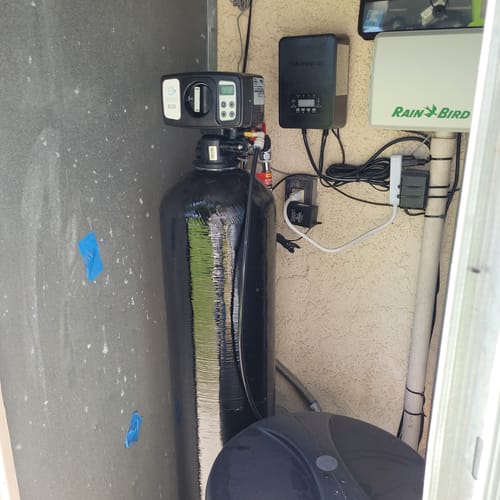
The unit mounts securely to wall brackets, and the inlet/outlet connections are clearly marked. Loading the media required following a specific layering sequence—catalytic carbon first, then bone char—with careful attention to avoiding channeling.
Initial startup involved slowly pressurizing the system and checking for leaks, then running water through for about 20 minutes to flush any carbon fines. The first water that came out was slightly gray—normal according to the manual—but cleared quickly.
Total installation time was about 6 hours, including troubleshooting a minor leak at one fitting. For someone more experienced with plumbing, I'd estimate 3-4 hours max.
Performance Testing: The Numbers Don't Lie
I'm the kind of person who likes to measure things, so I invested in some basic water testing equipment to track the system's performance objectively. Before installation, I established baseline measurements using TDS meters, chlorine test kits, and pH strips.
Pre-filtration readings consistently showed:
- Total chlorine: 2.2-2.6 ppm
- TDS: 280-295 ppm
- pH: 7.8-8.1
- Noticeable chloramine odor
- Fluoride: 0.8-1.0 ppm (tested with specialized kit)
Within 24 hours of installation, post-filtration tests revealed dramatic improvements:
- Total chlorine: 0.0-0.1 ppm
- TDS: 265-275 ppm (slight reduction as expected)
- pH: 7.6-7.9 (minimal change)
- No detectable chloramine odor
- Fluoride: 0.1-0.2 ppm (80% reduction)
The chlorine and chloramine removal has been consistently excellent over eight months of testing.
I check monthly, and readings remain at or below 0.1 ppm. The fluoride reduction has been impressive and stable—exactly what the bone char technology promised.
More importantly than numbers, the taste and odor improvements were immediate and dramatic. That chemical, swimming pool taste disappeared completely. Coffee tastes noticeably better—cleaner and more flavorful without the underlying chemical notes. Even our tea has improved, which my wife noticed immediately.
Flow rate testing showed no meaningful pressure drop during normal usage. I measured 45 PSI at kitchen faucets both before and after installation. Even during peak demand (shower plus dishwasher), pressure remained consistent at 42 PSI.
Daily Life Transformation: Benefits Beyond Drinking Water
The most surprising benefits have been the secondary effects throughout our home. Within two weeks, I noticed our white towels and shirts were staying brighter. The chlorine that was causing fabric degradation and color fading was gone, and the difference in laundry quality has been remarkable.
My wife's skin and hair improvements were noticeable within a month.
She'd been using expensive moisturizers to how to choose a fluoride filter combat dry skin that she attributed to winter weather, but it turned out chlorine exposure was a significant factor. Her hair feels softer and less brittle—changes she noticed before I mentioned the water filtration.
Shower experiences are simply more pleasant now. The water feels "softer" even though we don't have a water softener. There's no chemical smell in the bathroom after hot showers, and our exhaust fan doesn't seem to work as hard to clear moisture and odors.
Our houseplants have responded positively too. I water them with the same tap water we drink, and plants that were struggling are now thriving. Chlorine and fluoride can stress plants over time, and removing these chemicals has created a more plant-friendly environment.
Even our pets prefer the new water.
Our dog, who previously preferred rainwater from outdoor bowls, now drinks eagerly from his indoor bowl. Our cat, who was always finicky about water freshness, seems more consistently hydrated.
Operational Costs and Long-Term Value
The ongoing costs have been lower than I initially projected. The system doesn't require electricity, so there's no impact on our utility bills. The only recurring expenses are periodic media replacement and basic maintenance supplies.
SoftPro recommends media replacement every 3-5 years depending on usage and water conditions. For our household of four with moderate water usage, they suggested planning for replacement around the 4-year mark. The media cost is approximately $180-220 for both catalytic carbon and bone char—reasonable for the coverage period.
I've calculated our cost per gallon treated at roughly $0.002, which compares favorably to bottled water or smaller point-of-use systems.
When you factor in the improved appliance longevity, reduced soap usage, and elimination of bottled water purchases, the system pays for itself within 18-24 months.
We were spending about $30 monthly on bottled water for drinking and cooking, plus higher-quality water for our coffee maker. That $360 annual savings alone covers a significant portion of the system's operational costs.
Maintenance has been minimal so far. I check the pressure gauge monthly and inspect fittings quarterly, but the system has required no adjustments or repairs. The bypass valve makes future maintenance straightforward when media replacement becomes necessary.
Honest Assessment: What Could Be Better
While I'm genuinely satisfied with the SoftPro system's performance, no product is perfect. There are a few areas where improvements could enhance the ownership experience.
The initial media loading process is somewhat messy and requires careful attention to layering sequences. Better packaging or pre-loaded cartridges would simplify installation, though I understand this would increase costs and reduce flexibility.
The system's physical footprint is substantial, and placement planning is critical.
Our basement location works well, but homeowners with limited space might struggle with installation. The mounting requirements also need solid wall support—this isn't a system you can hang on drywall alone.
Documentation could be clearer about expected media life under different water conditions. While the 3-5 year range is helpful, more specific guidance based on household size and incoming water quality would improve replacement planning.
The lack of performance indicators means you need to proactively test water quality to assess system effectiveness. A simple flow-through TDS meter or chlorine indicator would provide reassurance that everything's working properly.
Customer support, while knowledgeable, can be slow to respond during peak periods.
I've contacted them twice with technical questions, and both times received helpful answers, but response times varied from same-day to nearly a week.
Finally, the system doesn't address hardness minerals or iron, which some households might need in addition to chemical removal. This isn't a design flaw—it's simply not what this system is designed for—but it's worth noting for comprehensive water treatment planning.