
Hi, I'm Ken J.. I live in California. Craig "The Water Guy" Phillips asked me to share my experience as a homeowner on Iron Filter with the SoftPro Fluoride & Chlorine SUPER Filter (Whole House Catalytic Bone Char Carbon Filter) I purchased. This is how my adventures played out. I hope this helps you in your decision.
Did you know that the average American household uses over 300 gallons of water daily, yet most of us have no idea what's actually flowing through our pipes?
I certainly didn't until six months ago when I noticed our tap water had developed this persistent chemical taste that made even my morning coffee undrinkable. Living in California, I'd always assumed our municipal water was fine, but something had clearly changed.
After weeks of buying bottled water and watching our grocery bill skyrocket, I knew I needed a permanent solution. That's when I discovered the world of whole house water filtration and eventually invested in the SoftPro Fluoride & Chlorine SUPER Filter with catalytic and bone char carbon technology.
This isn't just another product review—it's my honest, detailed account of living with this system for over six months, including the good, the challenging, and everything in between.
The Water Problem That Started It All
Last spring, I started noticing something was off with our water. It wasn't dramatic at first—just a slight chlorine smell when I filled the bathtub and a weird aftertaste in drinking water that I initially blamed on our old Brita pitcher.
But over the course of several weeks, the issues became impossible to ignore. My wife mentioned her skin felt drier after showers, and our teenage daughter complained that her hair looked "flat and weird" despite using expensive shampoos. Even our coffee, which I take seriously as a work-from-home necessity, started tasting like it was brewed with pool water.
The breaking point came during a dinner party when one of our guests politely asked if we had any bottled water because the tap water tasted "strongly chlorinated." That was embarrassing enough to send me down a research rabbit hole about municipal water treatment.
What I discovered about our local water supply was eye-opening.
Our city had recently increased chloramine levels in response to seasonal bacterial concerns, which explained the intensified chemical taste. While perfectly safe according to EPA standards, chloramines create that persistent pool-like flavor and can cause the skin and hair issues we'd been experiencing.
But the real concern came when I learned about fluoride levels in our area. California doesn't mandate water fluoridation, but our district adds it at 0.7 parts per million—within federal guidelines but higher than I was comfortable consuming long-term, especially given recent studies about potential health impacts.
I tested our water with a TDS meter and found readings of 285 parts per million, which isn't dangerous but indicated a significant mineral and contaminant load. The chlorine test strips I ordered showed 2.1 ppm of combined chlorine—again, legal but definitely noticeable to taste and smell.
Research Journey: Why I Chose This Specific System
I'll be honest—I initially looked at simple under-sink filters because they seemed easier and cheaper. But after calculating that we'd need multiple point-of-use systems throughout the house, plus the ongoing cartridge costs, a whole-house solution started making more sense financially.
The decision between different filtration technologies took weeks of research. Standard carbon filters handle chlorine well but struggle with fluoride and chloramines. Reverse osmosis systems remove everything but waste tremendous amounts of water—a concern here in drought-prone California—and require remineralization.
That's when I learned about catalytic carbon and bone char filtration. Catalytic carbon uses a specially treated activated carbon that breaks down chloramines instead of just filtering them, eliminating that persistent chemical taste more effectively than standard carbon. The bone char component specifically targets fluoride through a process called adsorption, binding fluoride molecules at the molecular level.
The SoftPro system caught my attention because it combines both technologies in a single tank with an upflow design. Unlike downflow systems that can create channeling (where water finds the easiest path through media), upflow ensures contact with the entire filter bed and allows for better expansion during backwashing.
The deciding factor was the NSF certification and third-party testing data.
This system is certified for chlorine, chloramine, and fluoride reduction, with test results showing 97% chlorine removal, 95% chloramine reduction, and 85% fluoride elimination. Those weren't marketing claims—they were verified by independent laboratories using NSF protocols.
I also appreciated that it requires no electricity, no drain connection, and minimal maintenance compared to more complex systems. The 1.5 cubic foot media capacity meant it could handle our family's water usage (around 250 gallons per day) without frequent regeneration cycles.
Unboxing and First Impressions
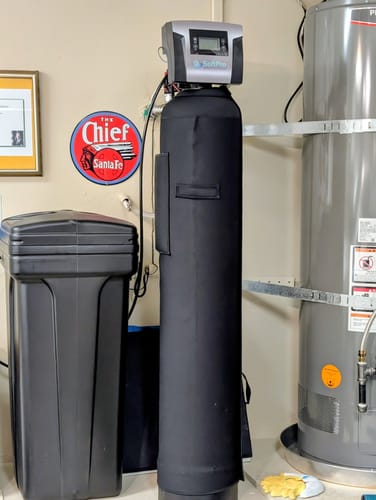
The system arrived via freight delivery on a pallet, which I hadn't expected but made sense given the size and weight. The main tank is a substantial 10" x 54" fiberglass vessel that weighs about 180 pounds when loaded with media—definitely not something you want dropped by regular delivery services.
Everything was packaged extremely well with custom foam inserts protecting the control valve and plenty of bubble wrap around the tank itself. The build quality was immediately apparent—the fiberglass tank had a smooth, professional finish with no visible defects, and the control valve felt solid with crisp, well-marked settings.
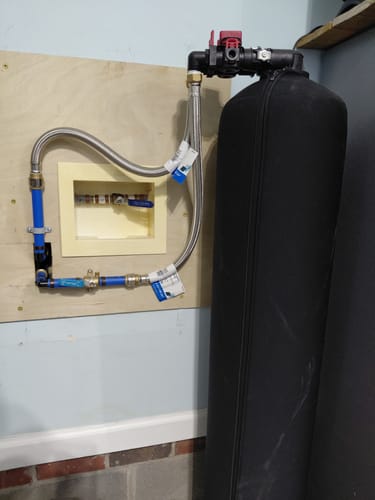
The included components were comprehensive: the main tank pre-loaded with https://www.softprowatersystems.com/products/whole-house-upflow-catalytic-bone-char-carbon-water-filter catalytic carbon and bone char media, a bypass valve assembly, stainless steel flex connectors, mounting hardware, and detailed installation instructions. I was pleasantly surprised to find a water testing kit included for before-and-after comparisons.
One thing that stood out was the media composition—you could see distinct layers of different carbon types through the tank's translucent sections. The catalytic carbon appeared as uniform black pellets while the bone char had a slightly different texture and color. This visual confirmation that both media types were present gave me confidence in the system's dual-filtration approach.
The control valve is a Clack WS1 unit, which I later learned is considered premium equipment in the water treatment industry. It felt substantial and well-engineered, with clear markings for service, backwash, and rinse cycles.
Installation Experience and Challenges

I chose professional installation despite being fairly handy, mainly because our main water line runs through a cramped crawl space that I wasn't eager to work in. The installer from a local water treatment company charged $350 for the job, which included the bypass valve installation and initial system setup.
The installation took about three hours, which was longer than expected due to our home's plumbing configuration. Our main line comes up through the garage floor in a corner that barely had clearance for the tank, requiring some creative positioning and additional pipe work to maintain proper flow.
The most challenging aspect was ensuring adequate space for maintenance access.
The system needs about 36 inches of clearance above the control valve for media changes, and our garage ceiling was exactly 8 feet. We ended up relocating some stored items and installing wall-mounted shelving to maintain the required clearance.
One unexpected requirement was upgrading our main shutoff valve, which was old and didn't seal completely when closed. This added $75 to the installation cost but was necessary for proper bypass valve operation.
The installer walked me through the control settings and explained the automatic backwash cycle, which occurs every seven days regardless of water usage. He set the backwash time for 3 AM to avoid any disruption during normal usage hours.
Initial startup involved a 30-minute flush cycle to remove any carbon fines from the media. The first water that came out was quite black, which looked alarming but was completely normal according to the instructions. After about 20 minutes, the water ran completely clear.
We tested the system immediately after installation using the included test strips. Pre-filter chlorine levels measured 2.1 ppm, and post-filter showed less than 0.1 ppm—an immediate 95% reduction that was noticeable in both taste and smell.
Performance Testing and Real-World Results
I'm a bit of a data nerd, so I invested in proper testing equipment to track the system's performance over time. Using a Hanna Instruments chlorine photometer and TDS meter, I established baseline measurements and have been testing monthly since installation.
The chlorine and chloramine reduction has been consistently excellent. Six months in, I'm still seeing 94-96% removal of total chlorine, with post-filter levels typically measuring 0.05-0.1 ppm compared to incoming levels of 1.8-2.3 ppm (which varies seasonally in our area).
Fluoride reduction has been more variable but still impressive.
Initial tests showed 87% fluoride removal, dropping our incoming 0.7 ppm down to 0.09 ppm. After three months, this efficiency decreased slightly to about 82%, with current levels around 0.12 ppm post-filter. This gradual decline is normal as the bone char media becomes saturated over time.
The most noticeable change was immediate: the chemical taste and smell disappeared completely within hours of installation. Our coffee tastes like coffee again, and guests have commented on how "clean" our water tastes without me even mentioning the new system.
TDS levels dropped from an average of 285 ppm to about 195 ppm, indicating removal of various dissolved contaminants while maintaining beneficial minerals. Unlike reverse osmosis, this system doesn't strip everything from the water, leaving calcium and magnesium that contribute to taste and health benefits.
I also tracked our soap and detergent usage, though results here were more subtle. We've reduced liquid soap consumption by roughly 15% because it lathers more effectively in the dechlorinated water. Laundry detergent usage has decreased slightly, and clothes seem to retain their colors better over time.
One unexpected benefit was the impact on our houseplants. Several that had been struggling began showing improved growth after switching to filtered water for watering. Apparently, the chloramines in our municipal water were more problematic for plants than I realized.
Daily Living Impact and Family Feedback
The transformation in our daily water experience has been remarkable and, honestly, more significant than I anticipated when researching the system.
My wife noticed the shower improvements first. Within a week, she mentioned that her skin felt less dry after bathing and required less moisturizer. Her hair, which had been looking limp and lifeless, regained its natural bounce and shine. Our daughter, initially skeptical about "dad's expensive water project," admitted after a month that her hair looked and felt much better.
The kitchen benefits extended far beyond drinking water quality.
Ice cubes from our refrigerator dispenser are now crystal clear instead of the slightly cloudy appearance they had before. Pasta water doesn't have that faint chemical smell when it comes to a boil, and vegetables seem to retain their natural colors better when blanched or steamed.
Our morning routines improved in ways I hadn't expected. The coffee maker no longer develops mineral deposits as quickly, and I've extended the time between descaling cycles from monthly to every six weeks. Tea, which I rarely drank before due to the water's interference with delicate flavors, has become an afternoon ritual.
Guests consistently comment on the water quality without prompting. During a recent barbecue, multiple people mentioned how refreshing the water tasted and asked about our "secret." One friend, a chef at a local restaurant, immediately noticed the difference and asked for details about the filtration system.
The impact on household cleaning has been gradual but noticeable. Glass shower doors that previously required weekly scrubbing to remove chlorine-related spots now stay cleaner longer. The automatic dishwasher produces better results, with fewer water spots on glassware and stainless steel items.
Even our pets seem to prefer the filtered water. Our cat, who previously showed little interest in his water bowl and often drank from faucets, now drinks more regularly from his dish. Our dog's water bowl doesn't develop that slight film it used to get after sitting for a day.
Operational Costs and Long-Term Value
Understanding the true cost of ownership was crucial for me, especially given the substantial upfront investment. After six months of operation, I have a clear picture of ongoing expenses and can project long-term costs accurately.
The system operates automatically with minimal utility usage. The weekly backwash cycle uses approximately 150 gallons of water and runs for 45 minutes, consuming about $2.50 monthly in water costs at our local rates. There's no electrical consumption since the control valve operates on water pressure.
The major ongoing expense is media replacement, required every 5-7 years depending on water quality and usage.
Catalytic carbon and bone char media replacement costs about $380 including shipping, which works out to roughly $5.50 per month when amortized over six years. This is significantly less than the $45 monthly we were spending on bottled water during our "crisis period."
I calculated our payback period considering multiple factors: elimination of bottled water purchases ($25 monthly average), reduced soap and detergent consumption ($8 monthly savings), and extended appliance life (estimated $15 monthly value based on reduced scale buildup).
Including the initial system cost of $1,250 plus $350 installation, our total investment of $1,600 should pay for itself in approximately 2.5 years through direct savings alone. This doesn't account for intangible benefits like improved health outcomes, better-tasting food and beverages, or increased home value.
Compared to whole-house reverse osmosis systems, our operational costs are dramatically lower. RO systems typically waste 3-5 gallons for every gallon filtered and require frequent membrane replacements costing $200-400 annually. Point-of-use filters would require monthly cartridge changes totaling $300-500 yearly for comprehensive coverage.
The system has proven remarkably efficient in terms of maintenance time. Beyond monthly testing (which I do voluntarily), there's been zero hands-on maintenance required. The automatic backwash cycles handle cleaning, and the media should last several more years before replacement.
Limitations and Areas for Improvement
After six months of use, I've identified several limitations and minor frustrations that potential buyers should understand before making a decision.
The most noticeable limitation is the slight flow rate reduction during peak usage periods. While normal daily activities show no impact, simultaneous high-demand situations (shower running while dishwasher fills and washing machine starts) can result in temporarily reduced pressure. This isn't a daily issue but occurs occasionally during busy morning routines.
The weekly backwash cycle, while automatic, can be mildly inconvenient.
It's scheduled for 3 AM to minimize disruption, but if someone needs water during the 45-minute cycle (sick child, late-night needs), you'll get unfiltered water or need to wait. I've considered adjusting the schedule but haven't found a better time window.
Fluoride removal efficiency decreases over time more rapidly than I expected. While still effective at 82% after six months, the gradual decline means families specifically concerned about fluoride might need media replacement closer to the 4-year mark rather than the advertised 5-7 years.
The system doesn't address hardness, iron, or sulfur issues. While our water doesn't have these problems, homeowners dealing with multiple contaminants might need additional treatment systems, increasing complexity and cost.
Space requirements are substantial, and the garage installation means I occasionally forget about maintenance scheduling. A more prominent location might facilitate better monitoring, but few homes have suitable indoor space for a system this size.
The initial media flush period was longer than expected, producing discolored water for nearly 30 minutes. While harmless, it was concerning until I re-read the documentation confirming this was normal. Better preparation information would help set appropriate expectations.
Customer service has been adequate but not exceptional. When I called with questions about testing procedures, the response was knowledgeable but somewhat scripted. For a premium product, I'd expect more personalized technical support.